 PRODUCT
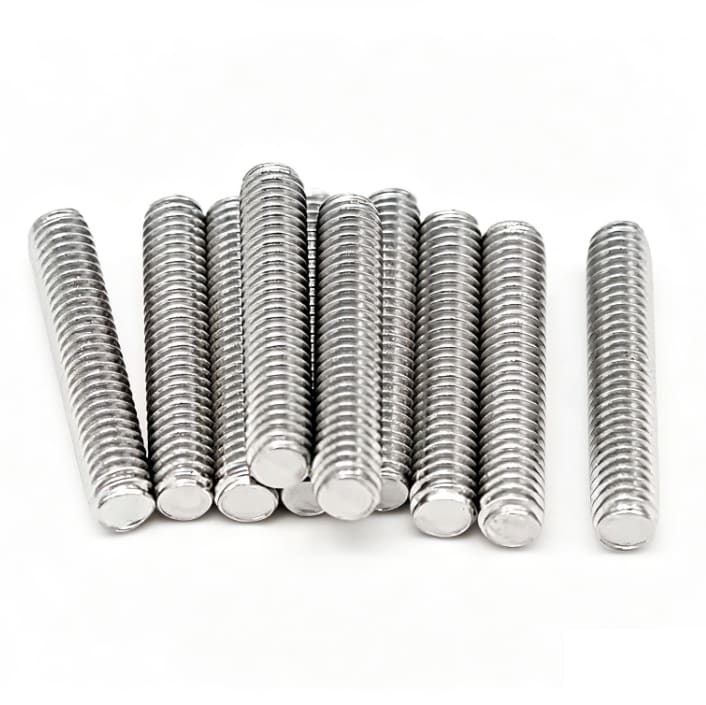
Full Thread Stud Bolt ASTM A193 B8M Stainless Steel for High Pressure Flange and Corrosion Resistant Pipeline Connections
ASTM A193 B8M Class 1 full thread studs, 1/4–4 in UNC/UNF/8UN to ASME B18.31.2 Table 1. 316 stainless for flange and pipeline duty. Request a quote.
Product Details
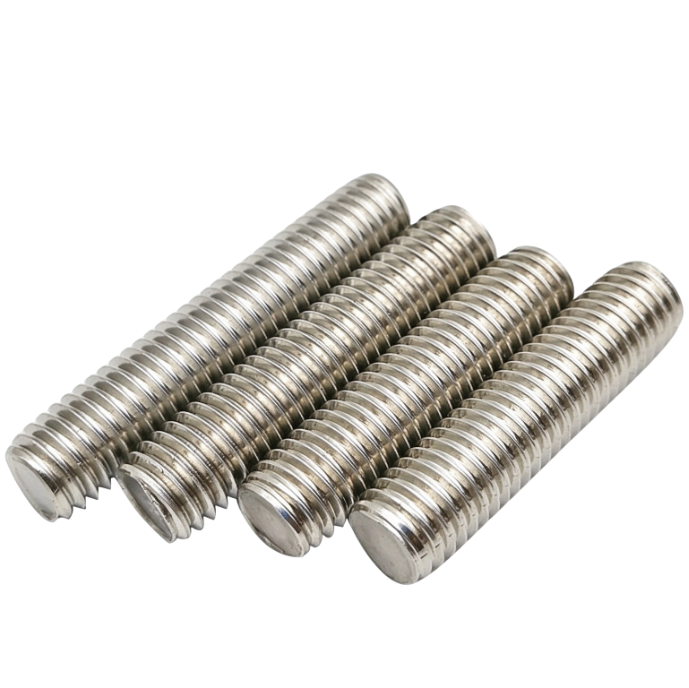
This stud follows the continuous thread stud dimensions of ASME B18.31.2-2014, Table 1, in the inch series. The table covers studs used with the A193/A193M, A320/A320M, A437/A437M, A453/A453M, A540/A540M and A1014/A1014M bolting material specifications. The thread runs from end to end, so the stud can be cut to the required length and used with a nut at each end or with one nut and a tapped component.
The material is ASTM A193/A193M Grade B8M, the 316 stainless steel bolting grade, in Class 1 condition. UNS S31600 contains molybdenum in addition to chromium and nickel, which improves resistance to pitting and crevice corrosion compared with the 304-type B8 grade. The grade is selected for bolted joints that combine mechanical load with elevated temperature or corrosive service.
Typical applications include petrochemical and chemical piping, heat exchangers, pressure vessels, valve and pump flanges, offshore and marine structures, and other equipment exposed to moisture, chlorides or elevated temperature. The final selection depends on the design code, the operating temperature, the medium and the required strength.
Product Specifications
| Item | Details |
|---|---|
| Product Name | Full Thread Stud Bolt, continuous thread stud |
| Dimensional Standard | ASME B18.31.2-2014, Table 1 |
| Material Standard | ASTM A193/A193M |
| Grade and Class | B8M Class 1, carbide solution treated |
| Alternative Class | B8M Class 2, strain hardened, on request |
| Material | 316 stainless steel, UNS S31600 |
| Form | Continuous thread, full length |
| Size Range | 1/4 in to 4 in |
| Thread Series | UNC, UNF and 8UN as listed in Table 1 |
| Length | Cut to the required length; state the finished length |
| End Finish | Chamfered, ends perpendicular to the axis |
| Chamfer | From major diameter to not more than minor diameter, 1 to 2 pitches |
| Surface Condition | Passivated or pickled and passivated |
| Matching Nut | ASTM A194 Grade 8M |
| Marking | Grade and heat number, as agreed |
| Packaging | Confirmed with the order requirements |
The table describes the product form and the references that apply to it. The actual size, thread series, length, class, finish and inspection requirements are confirmed for the quoted item.
Material: A193 B8M Class 1
B8M is an austenitic stainless steel of the 316 type. The molybdenum content is the main difference from B8, which is the 304 type. Molybdenum raises resistance to pitting in chloride-bearing environments, so B8M is preferred for coastal, marine and many chemical process applications.
Class 1 is supplied in the carbide solution treated condition. It combines moderate strength with good ductility and is the most widely used class for general flange and pipeline bolting. Class 2 is additionally strain hardened to raise tensile and yield strength, with some reduction in elongation. Class 2 should be selected only when the joint design calls for the higher strength level.
| Element | C | Si | Mn | P | S | Cr | Ni | Mo |
|---|---|---|---|---|---|---|---|---|
| Minimum (%) | - | - | - | - | - | 16.0 | 10.0 | 2.00 |
| Maximum (%) | 0.08 | 1.00 | 2.00 | 0.045 | 0.030 | 18.0 | 14.0 | 3.00 |
The composition above is the A193 B8M requirement. Bismuth, selenium, tellurium and lead are not intentionally added.
Thread Series and Size Range
ASME B18.31.2 Table 1 lists continuous thread studs from 1/4 in to 4 in. The table gives the thread diameter, the threads per inch for the UNC, UNF and 8UN series, and the corresponding thread limits. The 8UN series applies to the larger sizes, where a uniform eight-thread pitch is used instead of a size-specific coarse pitch.
| Nominal Size | UNC (TPI) | UNF (TPI) | 8UN (TPI) |
|---|---|---|---|
| 1/2 in | 13 | 20 | - |
| 5/8 in | 11 | 18 | - |
| 3/4 in | 10 | 16 | - |
| 7/8 in | 9 | 14 | - |
| 1 in | 8 | 12 | 8 |
| 1-1/8 in | 7 | 12 | 8 |
| 1-1/4 in | 7 | 12 | 8 |
| 1-3/8 in | 6 | 12 | 8 |
| 1-1/2 in | 6 | 12 | 8 |
| 2 in | 4-1/2 | - | 8 |
Sizes below 1/2 in and above 2 in are also listed in Table 1. State the nominal size and the thread series together, because the same nominal diameter can have a different pitch in UNC, UNF and 8UN.
End Chamfer and Marking
The end chamfer runs from the stud major diameter to a diameter not larger than the minor diameter. The chamfered end extends one to two pitches before the full thread starts. Both ends are perpendicular to the stud axis, and the ends are suitable for marking.
The chamfer allows the stud to start cleanly in a nut or a tapped hole and avoids a sharp edge at the thread run-out. If a stud is cut from a longer piece, the cut end should be deburred and chamfered to the same form before use.
Marking typically includes the grade designation and the heat number, applied to one end. The heat number links the finished stud to the mill certificate. If the project requires a specific marking layout, certificate type or third-party inspection, state it with the inquiry.
Corrosion Resistance and Service Conditions
316 stainless steel performs well in many atmospheric, fresh water, marine and chemical environments, but it is not immune to corrosion. Resistance depends on the chloride concentration, temperature, pH, oxygen level and the presence of crevices. Stagnant chloride-bearing water and tight crevices are more aggressive than the same medium in free-flowing conditions.
For elevated-temperature service, the allowable stress and the maximum temperature should be taken from the design code that governs the equipment, such as the applicable section of the ASME Boiler and Pressure Vessel Code. A193 B8M is a bolting material specification; it does not by itself set the design temperature or the allowable stress of the joint.
Galvanic corrosion should be considered when B8M studs are used with flanges or nuts of a different material. In wet or conductive service, a dissimilar couple can accelerate attack on the less noble component. Insulating kits or a compatible material combination may be required.
Surface Finish and Traceability
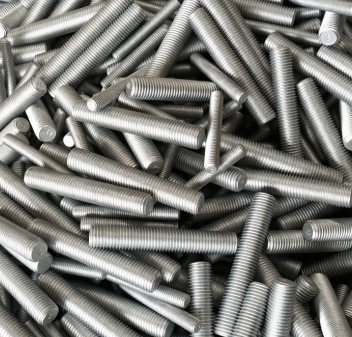
B8M studs are supplied in the stainless condition and are normally passivated or pickled and passivated after machining. Passivation removes free iron and other surface contamination and helps the natural passive film to form. It is a cleaning process, not an applied coating.
Zinc plating, hot dip galvanizing and zinc flake coatings are intended for carbon and alloy steel fasteners. They are not a normal finish for B8M studs and should not be specified as a substitute for passivation. If a coated finish is required for a specific project, the effect on the stainless surface and on the threaded fit should be reviewed first.
Ordering Details
When ordering, state the nominal size, thread series, finished length, class, surface condition, nut grade and quantity. The continuous thread form has no fixed thread length, so the finished length is the controlling dimension.
If the stud replaces an existing part, provide the drawing or a sample so that the thread series, diameter and end chamfer can be matched. For studs that will be cut from a longer piece, state whether the cut end must be chamfered and whether the thread must be inspected after cutting.
FAQ
1.What is a continuous thread stud?
It is a stud with a thread running from end to end. ASME B18.31.2 Table 1 gives its inch-series dimensions. It differs from a clamping type double end stud, which has a threaded end at each end and an unthreaded shank in the middle.
2.Which sizes are covered by Table 1?
The table covers nominal sizes from 1/4 in to 4 in, with UNC, UNF and 8UN thread series. The 8UN series applies to the larger sizes.
3.What is the difference between A193 B8 and B8M?
B8 is the 304 type and B8M is the 316 type. B8M contains 2.00 to 3.00 percent molybdenum, which improves resistance to pitting and crevice corrosion in chloride-bearing environments.
4.What is the difference between Class 1 and Class 2?
Class 1 is carbide solution treated and has lower strength with higher ductility. Class 2 is solution treated and strain hardened, giving higher tensile and yield strength with lower elongation. Class 1 is the usual choice unless the design calls for Class 2.
5.Which nut should be used with a B8M stud?
ASTM A194 Grade 8M is the matching nut grade. Using a nut of a different grade or material should be checked against the design code, the preload requirement and the corrosion environment.
6.Can B8M studs be zinc plated?
They are normally passivated rather than plated. Zinc and zinc flake coatings are designed for carbon and alloy steel, and plating a stainless stud is not a standard finish. Confirm any special coating requirement with the inquiry.
7.How is the length specified?
State the finished length from end to end. Because the thread is continuous, the stud can be cut to length, but the cut end should be deburred and chamfered before use.
----
Sendthe nominal size, thread series, finished length, class, surface condition, required nut grade and quantity.Drawings, samples and existing part numbers can be reviewed against the quoted configuration.