 PRODUCT
Cross Recessed Countersunk Head Self-Drilling Screw DIN 7504 P Steel Fastener for Flush Metal Panel Assembly
DIN 7504P cross recessed countersunk self drilling screws in steel, ST2.9–ST6.3, 13–50 mm. For flush metal panel assembly; request a quotation.
- Standard
- DIN 7504 P:1982
- Material
- heat-treatable steel
Product Details
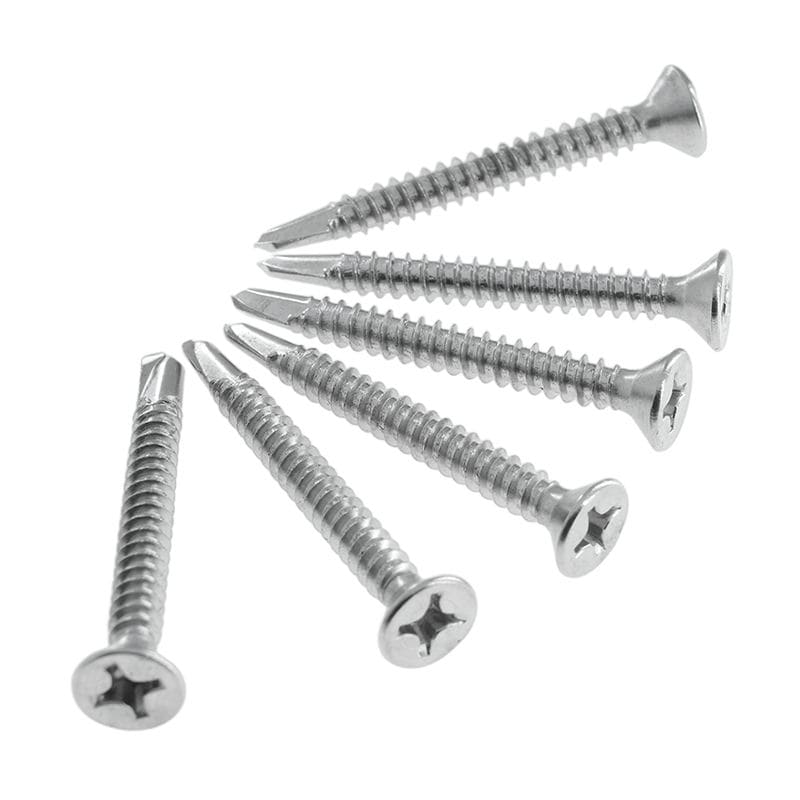
DIN 7504 P cross recessed countersunk head self-drilling screws combine a flat countersunk head, a cross recess drive and a drill point that forms its own hole in light-gauge metal. The head is designed to seat into a matching countersink so that the fastening point can finish close to flush with the surrounding panel surface. The ST tapping screw thread then forms a mating thread in the drilled material.
The screw is intended for metal-to-metal assembly where access is available from one side and the combined sheet thickness falls within the drilling range of the selected size. Typical work includes metal panels, cladding, ducting, light-gauge steel components and general sheet-metal assemblies. It is not a metric machine screw and should not be selected by an M diameter alone.
Product Specifications
| Item | Details |
|---|---|
| Product Name | Cross Recessed Countersunk Head Self-Drilling Screw |
| Standard Reference | DIN 7504 P:1982 |
| Product Family | Cross recessed countersunk head drilling screw with tapping screw thread |
| Head Type | Countersunk head with flat top |
| Drive Type | Cross recess |
| Thread Type | ST tapping screw thread |
| Thread Sizes | ST2.9, ST3.5, ST3.9, ST4.2, ST4.8, ST5.5 and ST6.3 |
| Nominal Lengths Listed | 13, 16, 19, 22, 25, 32, 38, 45 and 50 mm |
| Material According to Standard | Surface-hardened steel to DIN 17210 or heat-treatable steel to DIN 17200, at the manufacturer's option; other equivalent materials by agreement |
| Drilling Range | 0.7–6.0 mm plate thickness, depending on screw size |
| Surface Finish | Specify zinc plating, nickel plating, phosphating, black oxide, zinc-flake coating or another required finish in the inquiry; availability subject to agreement |
| Electroplated Coating Reference | GB/T 5267.1, where specified for the order |
| Packaging | Confirmed with the order requirements |
The values above describe the DIN 7504 P product form. The material grade, coating, size, length and acceptance requirements are confirmed for the quoted item.
Head Geometry and Flush Installation
The countersunk head has a flat top and a conical bearing surface. It is intended for a matching countersink in the outer panel. When the recess matches the head geometry, the top of the screw can sit close to the panel surface instead of standing above it.
Head diameter and head height change with the screw size. The head diameter ranges from 5.5 mm to 12.4 mm across the listed sizes, while the approximate head height ranges from 1.7 mm to 3.8 mm. A countersink prepared for one size should not be assumed to fit another size simply because both screws use a similar thread diameter.
The cross recess accepts a matching cross-head driver bit. The bit should engage the full recess and remain aligned with the screw during installation. A worn or undersized bit can slip, damage the recess or make final tightening difficult.
Self-Drilling Point and Thread Engagement
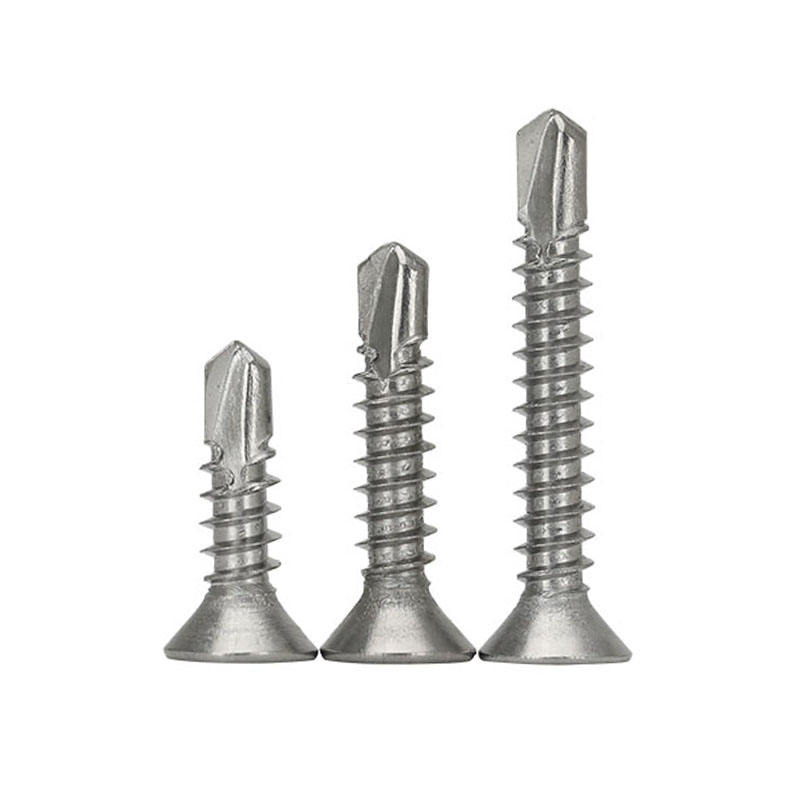
As the screw is driven, the drill point forms its own hole in the mating metal and the ST thread follows to form a matching thread. This allows the screw to be installed without a separate drilling operation when the material, tool and joint design are suitable.
The drill point diameter ranges from 2.3 mm to 5.8 mm across the listed sizes. The drilling range for each size is shown in the table below. The combined thickness of the materials being joined should fall within that range. Material that is too thin may not provide enough thread engagement, while material beyond the stated range may prevent the point from drilling through.
Screw length must also allow the point to pass through the joined sheets and the thread to engage the required thickness. For a replacement part or an existing assembly, the original screw, the total stack thickness and the required installed position should be checked together.
Size, Length and Drilling Range
| Thread Size | Pitch P (mm) | Head Diameter dk Max (mm) | Head Diameter dk Min (mm) | Head Height k Approx. (mm) | Cross Recess No. | Drill Point dp Max (mm) | Drilling Range — Plate Thickness (mm) |
|---|---|---|---|---|---|---|---|
| ST2.9 | 1.1 | 5.5 | 5.2 | 1.7 | 1 | 2.3 | 0.7–1.9 |
| ST3.5 | 1.3 | 6.8 | 6.44 | 2.1 | 2 | 2.8 | 0.7–2.25 |
| ST3.9 | 1.3 | 7.5 | 7.14 | 2.3 | 2 | 3.1 | 0.7–2.4 |
| ST4.2 | 1.4 | 8.1 | 7.74 | 2.5 | 2 | 3.6 | 1.75–3 |
| ST4.8 | 1.6 | 9.5 | 9.14 | 3.0 | 2 | 4.1 | 1.75–4.4 |
| ST5.5 | 1.8 | 10.8 | 10.37 | 3.4 | 3 | 4.8 | 1.75–5.25 |
| ST6.3 | 1.8 | 12.4 | 11.97 | 3.8 | 3 | 5.8 | 2–6 |
The listed nominal lengths are 13, 16, 19, 22, 25, 32, 38, 45 and 50 mm, but not every length is necessarily available for every thread size. State the thread size and nominal length together in the inquiry.
Material and Surface Condition
The DIN 7504 P reference permits surface-hardened steel to DIN 17210 or heat-treatable steel to DIN 17200, with the choice left to the manufacturer. Other equivalent materials may be used by agreement between the buyer and supplier.
Specify the material grade, hardness, coating and appearance requirements with the order. The DIN 7504 P designation alone should not be used to identify the surface finish. For electroplated screws, include GB/T 5267.1 where it forms part of the purchasing specification, together with the required coating system, thickness and corrosion-test acceptance criteria.
Requested finishes may include zinc plating, nickel plating, phosphating, black oxide or zinc-flake coating. State the required finish in the inquiry; availability for the selected material and size is subject to agreement. Phosphating, black oxide and zinc-flake coatings are separate treatment systems and should not be specified as electroplated coatings under GB/T 5267.1.
For outdoor, coastal, humid or dissimilar-metal service, describe the environment and the required coating performance so that the finish can be reviewed against the intended use. State any required salt-spray test method, duration and acceptance criteria explicitly; the product designation does not establish a particular corrosion-resistance rating.

FAQ
1.Is DIN 7504 P the same as DIN 7504 N or DIN 7504 K?
No. DIN 7504 P has a countersunk head, DIN 7504 N has a pan head and DIN 7504 K has a hex washer head. The head form and installed profile differ, so they should not be substituted without checking the joint design.
2.Is this a self-tapping screw or a self-drilling screw?
It is a self-drilling screw with a tapping screw thread. The drill point forms the hole, and the ST thread forms a mating thread in the drilled material.
3.Can an M-size machine screw be used instead of an ST-size screw?
No. ST tapping screw sizes and M metric machine thread sizes are different thread systems. A machine screw requires a pre-tapped hole or a matching nut, while this screw forms its own thread in the drilled material.
4.How do I choose the length?
Confirm the total thickness of the materials to be joined, the required thread engagement and the intended installed position. Then select a screw whose drilling range and length suit that joint. The screw size and length should be quoted together.
5.What information is needed for a quotation?
Provide the standard and edition, thread size, nominal length, required material, surface finish, quantity, application, combined plate thickness, inspection requirements and packaging requirements.
---
Send the required DIN 7504 P size, nominal length, material, surface finish and quantity, together with the application and combined material thickness. Drawings, samples or existing part references can be reviewed against the quoted configuration so that the head form, drill point and thread engagement suit the assembly.