Hot-Dip Galvanized Bolts vs. Stainless Steel Fasteners: How to Select by Life-Cycle Cost

Daniel
With experience in fastener manufacturing and export sales, we specialize in bolts, nuts, screws, self-drilling screws, fully threaded rods, and customized fastening solutions for construction, machinery, automotive, and industrial applications.
Why can't fastener selection be based solely on purchase unit price?
In on-site maintenance, rusted screws, seized nuts, and difficult bolt removal are extremely common problems. The more insidious situation is this: equipment runs normally last month, but this month it jams or loosens, and upon disassembly and inspection the fasteners are found to have suffered localized corrosion or preload decay. Such failures appear to be "small part" problems, but in reality they can cause downtime, rework, seal failure, or even safety risks, and their cost is often far higher than the purchase price of the fasteners themselves.
Therefore, hot-dip galvanizing and stainless steel are not simply a distinction between high and low grades. Selection should be based on a comprehensive judgment combining the corrosive environment, load requirements, installation conditions, maintenance cycle, and replacement cost. A solution that performs well in a dry indoor setting may fail completely in a coastal salt-spray environment; conversely, fully specifying high-grade stainless steel for a low-corrosion environment may also cause unnecessary cost waste.
The scope of comparison in this article is hot-dip galvanized carbon steel bolt assemblies versus common stainless steel fasteners, and it provides a reviewable full life-cycle cost calculation framework. It should be noted that corrosion statistics and cost data in the fastener industry vary greatly from project to project; this article does not cite industry averages that cannot be verified, and cases and figures should be based on project measurements, on-site records, or formal supplier quotations.
First, understand the two material systems: coating protection and stainless steel passivation
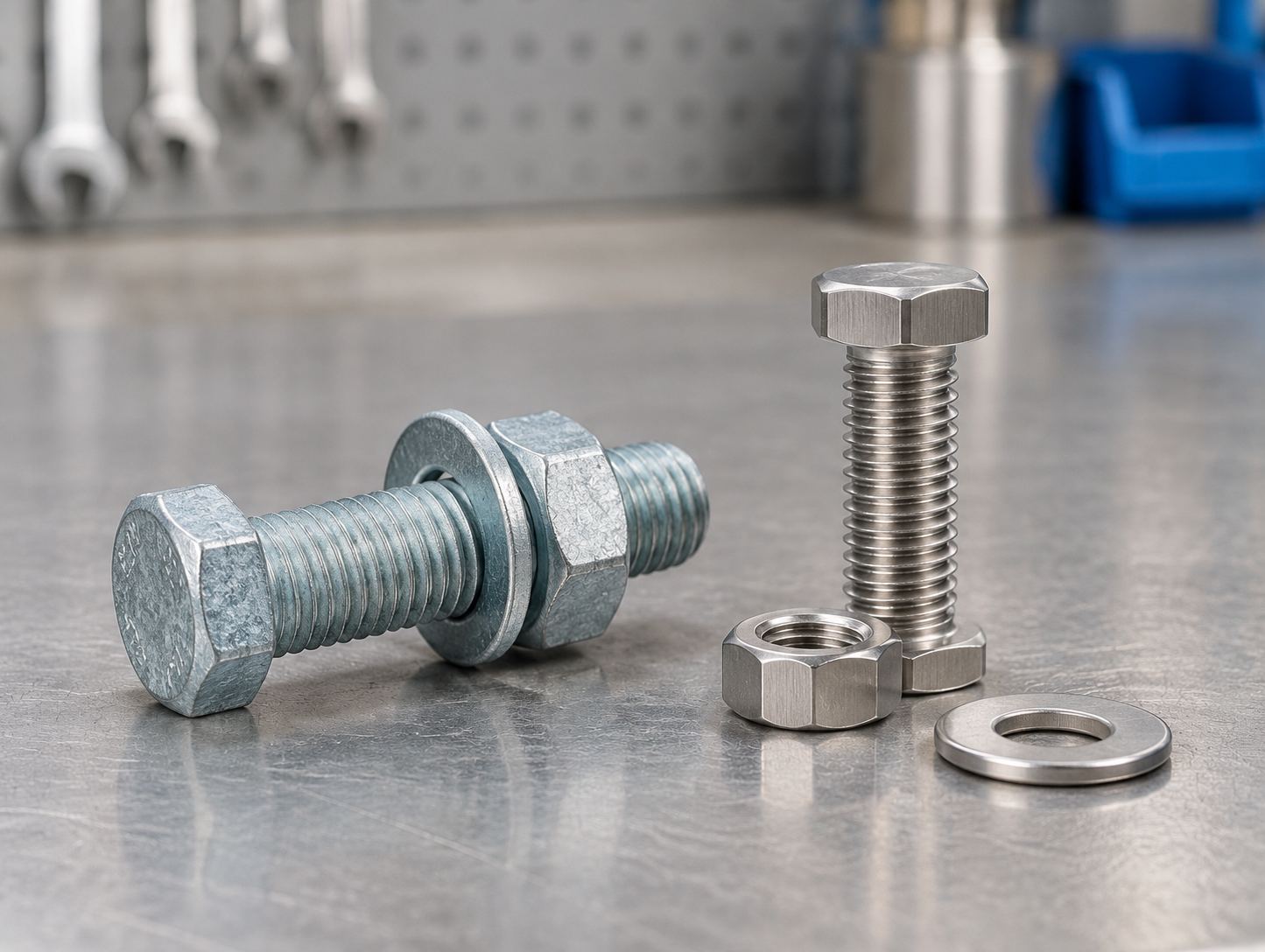
Hot-dip galvanized bolts rely on the zinc layer to provide barrier protection. When the coating is locally damaged, the zinc can also play a certain sacrificial anode role, delaying corrosion of the steel substrate. Its protective effect is affected by coating quality, thickness, completeness of edge coverage, and the degree of installation damage. If the coating is too thin at threads, corners, cut edges, and other locations, or is scratched during assembly, these often become the starting points of corrosion.
Stainless steel fasteners, on the other hand, rely on the surface passivation film for corrosion resistance. The corrosion resistance of common grades differs significantly, and suitability cannot be judged by the three words "stainless steel" alone. In chloride-containing environments, some grades may suffer pitting corrosion or crevice corrosion, so the grade must be verified in combination with the medium composition, temperature, and structural details.
Component matching is equally critical. The materials and surface treatments of bolts, nuts, and washers should match one another to avoid galvanic corrosion or abnormal assembly performance caused by mixing. For example, hot-dip galvanized bolts paired with stainless steel nuts may accelerate localized corrosion in humid environments; mixing different strength grades may also affect preload control.
In addition, the dimensional tolerances and thread fit of hot-dip galvanized parts require special attention, because the coating changes the actual thread dimensions; stainless steel parts carry a risk of galling, so lubrication, rotation speed, and torque must be controlled during installation. During selection, the applicable standards, strength grades, lubrication condition, and installation process should be checked, rather than looking only at the material name. For projects requiring complete sets, those withnon-standard fastener machiningcapabilities—fastener manufacturers can usually provide matching solutions for bolts, nuts, and washers at the same time, reducing the risk of on-site mixing.
Selection by corrosive environment: from dry indoors to marine and chemical media
Dry indoor or low-corrosion environments
In dry indoor environments with no corrosive media and controllable temperature and humidity, hot-dip galvanized bolts usually have a clear initial cost advantage. At this time, the environmental classification and design protection requirements should be confirmed, to avoid simply equating "indoor" with "non-corrosive." For scenarios such as cabinets, brackets, and light assembly,machine screw wholesaleand standard parts purchased together can further reduce overall costs.
General outdoor atmospheric environment
Outdoor environments require assessment of rainfall, surface wetness duration, atmospheric pollutants, and maintenance accessibility. The hot-dip galvanized layer can provide a relatively long protection cycle in the general atmosphere, but when exposed to humid and polluted environments for a long time, the coating consumption rate will accelerate. At this time, the coating system or specific stainless steel grade should be selected according to the project's environmental category and target service life, rather than being decided directly based on experience.
Coastal, sea salt spray, and deicing salt environments
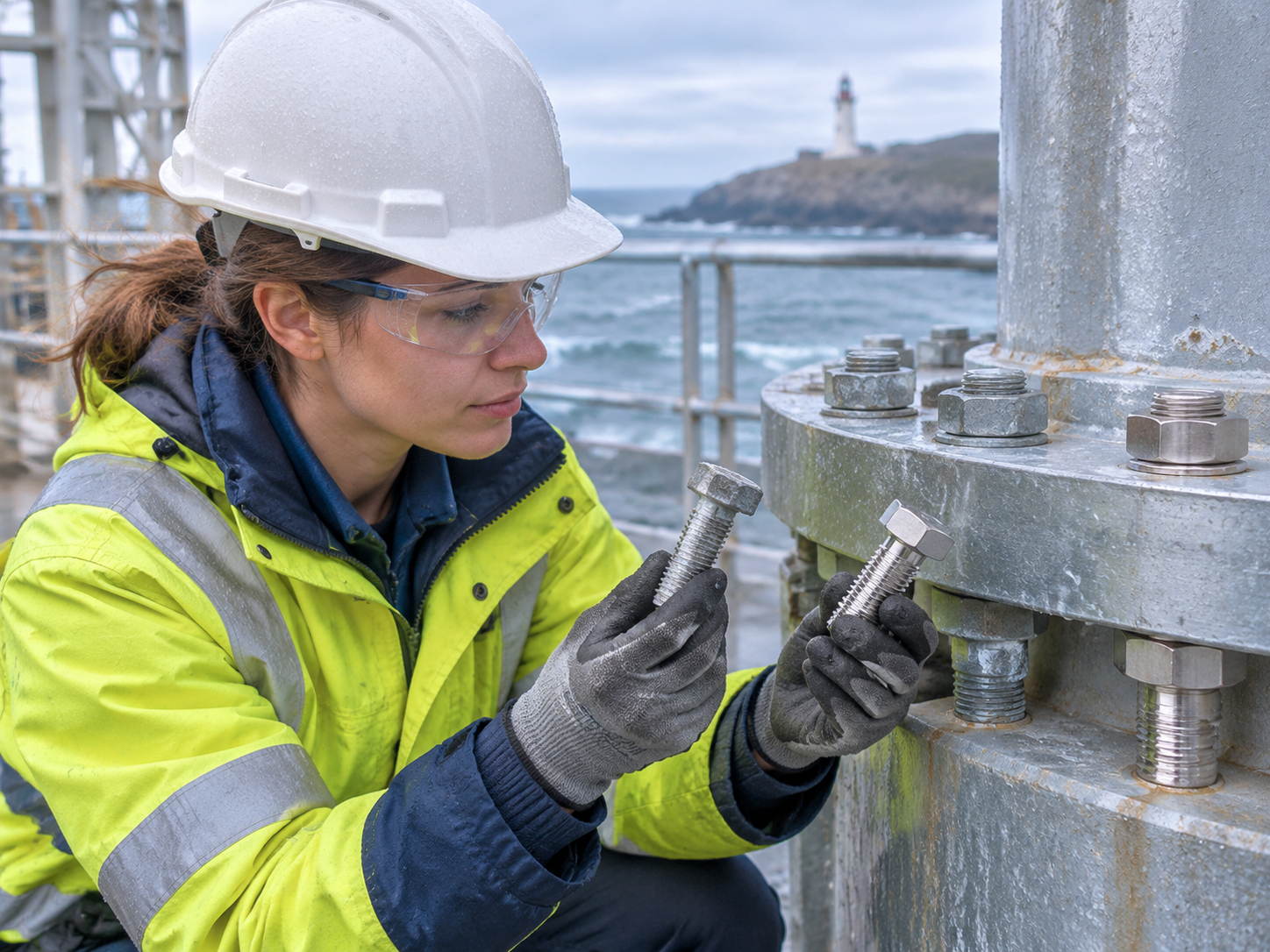
The core risks in such environments are chloride ions, crevice liquid accumulation, and contact between dissimilar metals. It cannot be generally assumed that all stainless steels are suitable; engineers must verify the grade and structural details to avoid crevice structures and liquid-trapping dead corners. For connections exposed to salt spray,hot-dip galvanized bolt supplierscan provide coating thickness and process descriptions, whilestainless steel fastener manufacturersshould provide grade certificates and batch traceability; both should be based on documents rather than verbal promises.
Chemical, wastewater, and high-temperature high-humidity environments
Chemical and wastewater environments require material compatibility assessment based on medium composition, temperature, concentration, and cleaning method. Some media corrode the zinc layer significantly, and some stainless steel grades may also fail at specific concentrations and temperatures. For such projects, sample verification or on-site coupon tests are recommended, and a corrosion engineer should be consulted when necessary.
Buried, wet crevices, and locations difficult to maintain
For buried parts or locations difficult to maintain, the feasibility of inspection and replacement is itself a selection variable. A solution with lower material cost but requiring replacement every five years may have a higher overall cost than a solution with higher initial investment. At this time, structural disassemblability, tool accessibility, and spare parts supply should all be included in the assessment.
Performance and construction comparison: strength, assembly, maintenance, and failure modes
First compare the strength grade, preload, and connection form required by the design, and ensure that the grades and standards of bolts, nuts, and washers match one another. For high-strength connection scenarios, products of the corresponding grade should be selected,High-strength bolt manufacturersUsually able to provide complete mechanical property and inspection documents.
During assembly, hot-dip galvanized threads require attention to the effect of the coating on mating dimensions; if necessary, use oversized tapping or matching nuts; stainless steel connections require control of lubrication, rotation speed, and installation torque to reduce the risk of galling and seizing. For locations requiring frequent disassembly and reassembly, evaluateLock nut suppliersprovided anti-loosening solutions to reduce preload loss caused by vibration.
Regarding failure modes, the risks of hot-dip galvanized parts are concentrated in local corrosion caused by coating scratches, cut edges, and water accumulation; stainless steel parts have pitting and crevice corrosion risks under chlorides, crevices, and improper cleaning conditions. Maintenance inspections should focus on corrosion and coating condition, nut loosening, connector seizing, preload changes, and ease of replacement.
In thin-sheet connections or assemblies requiring self-tapping forming,Self-tapping screw manufacturersandSelf-drilling screw suppliersprovide products that can reduce the pre-drilling process, but they likewise need to match sheet thickness, material, and corrosion protection requirements. For example, DIN 7972 slotted countersunk head self-tapping screws (steel, ST2.2–ST6.3) are suitable for flush countersunk installation and general assembly scenarios; their countersunk structure allows a flat surface after fastening, making them suitable for connections with limited space or appearance requirements; while DIN 7973 slotted raised countersunk head self-tapping screws have a raised head on the basis of the countersunk head, suitable for occasions requiring semi-countersunk assembly and a certain decorative effect. When selecting either type of product, it should be confirmed whether the base material's corrosion protection treatment meets the environment in which it will be used.
Life cycle cost (LCC) calculation: incorporate hidden costs into the comparison
Life cycle cost can be expanded according to the following formula:
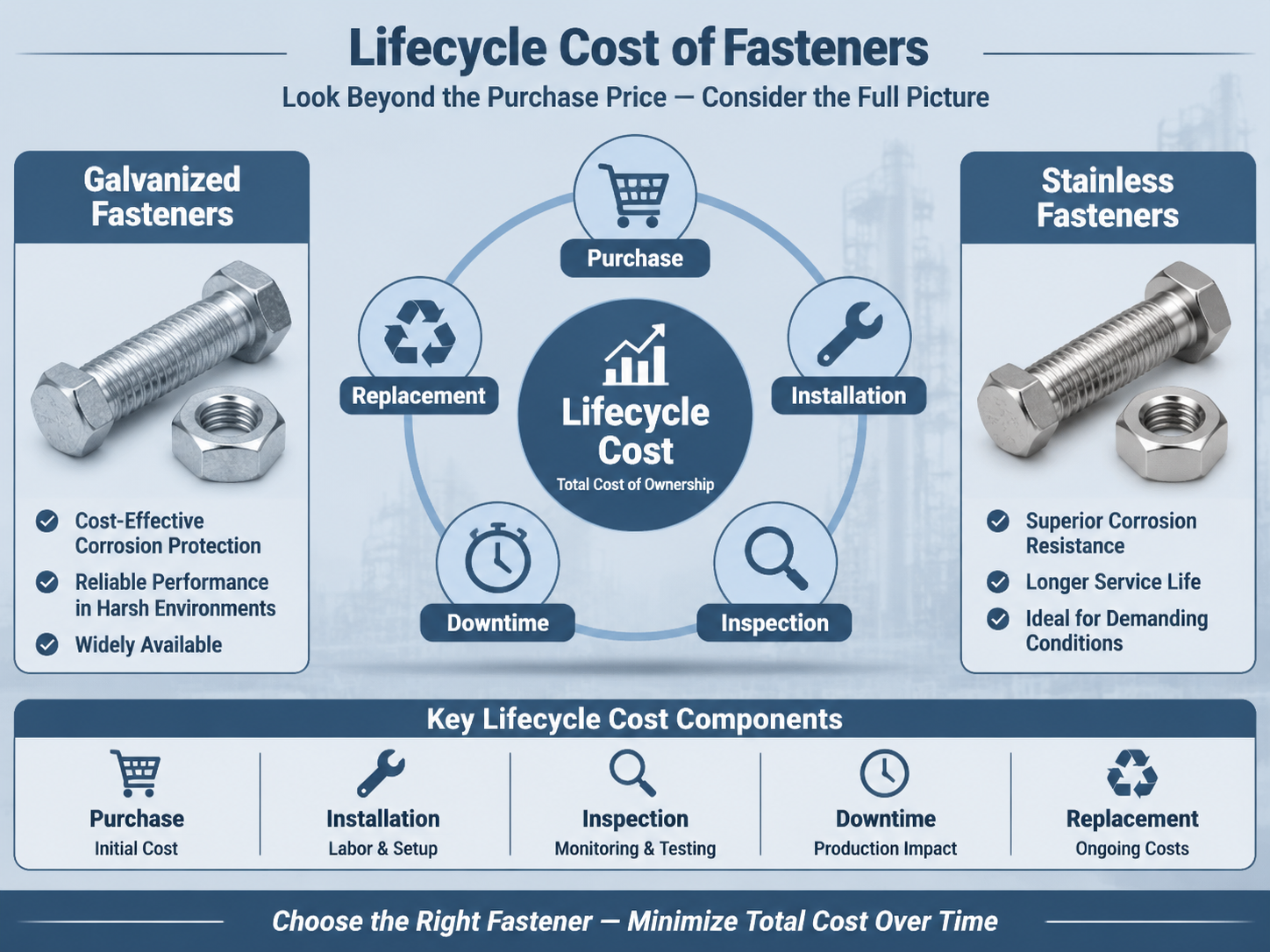
Life cycle cost = procurement and transportation cost + installation cost + inspection and maintenance cost + downtime and rework cost + replacement cost - residual value or recyclable value
Before calculation, the parameters must be clarified: number of fasteners, unit price, installation labor hours, target service life, inspection frequency, corrosion failure rate, downtime loss, and replacement accessibility. If any one is missing, the comparison conclusion may be distorted.
The calculation steps are suggested as follows:
- Determine the comparison period and discount rate; both options must use the same period;
- Collect formal quotations and construction data for the two options, including the cost of matching nuts, washers, and tools;
- Estimate maintenance, replacement, and downtime cash flows, listed by year;
- Compare total costs after discounting, rather than simply adding them together.
The example table structure can be set with the following columns: option name, initial cost, annual maintenance cost, estimated number of replacements, downtime loss, discounted total cost. Fill in the hot-dip galvanized option and the stainless steel option separately; all figures should come from project quotations and actual measurements, and industry average values should not be fabricated.
After completing the basic calculation, a sensitivity analysis should be carried out: test the impact of changes in corrosion rate, downtime loss, material unit price, and design life on the conclusion. If the conclusion reverses within a reasonable parameter range, it indicates that the decision is highly sensitive to a certain variable, and on-site data for that variable should be supplemented as a priority.
Selection decision process and common misconceptions
The recommended decision process is: identify the environment and medium → determine design life and load → select material and grade → check standards and matching components → evaluate construction and maintenance → complete the LCC comparison.
Common misconceptions include:
- Misconception 1: believing that stainless steel never rusts.It should be evaluated by grade, chloride ions, crevices, and temperature, with on-site verification if necessary.
- Misconception 2: judging service life only by coating appearance or nominal thickness.Quality documents, process consistency, and installation damage also need to be verified.
- Misconception 3: comparing only the unit price of bolts.Ignoring nuts, washers, installation labor, disassembly difficulty, and downtime costs often leads to misjudging the total cost.
- Misconception 4: Ignoring contact between dissimilar metals, thread fit, and tightening torque.This accelerates corrosion or leads to assembly failure.
For projects requiring custom structures,custom special-shaped fastenersandcustom socket head cap screwscan resolve space and anti-loosening issues at the design stage, avoiding later on-site modifications.
Procurement and supplier evaluation: from specification confirmation to quality traceability
During procurement, fastener suppliers should be required to confirm material grade, strength grade, applicable standards, surface treatment, dimensional tolerances, and inspection documents. For hot-dip galvanized bolts, verify the coating process and quality requirements; for stainless steel fasteners, verify grade certificates and batch traceability information.
For hex bolts, flange bolts, studs, and matching nuts, the compatibility and replaceability of the complete assembly should be confirmed. For connections involving heavy structures,heavy hex nut manufacturersandcarbon steel nut factoriescan provide matching-grade components; for pipeline or equipment flange connections,flange bolt supplierscan provide complete solutions with matching dimensions and pressure ratings.
Select hot-dip galvanized bolt suppliers, stainless steel fastener manufacturers, or fastener manufacturers with non-standard processing capabilities according to project requirements, and evaluate lead times, quality control, and after-sales response. Manufacturers with experience infastener OEM contract manufacturingand asfastener export suppliersare usually more standardized in document completeness and batch management; suppliers withASTM bolt exportbusiness are familiar with the corresponding standards systems. For bulk procurement,custom bolt wholesaleandexpansion bolt wholesalechannels can reduce unit prices, but it must be confirmed at the same time that quality documents do not shrink due to price.
It is recommended to first conduct sample verification or small-batch trial assembly; for high-risk projects, combine environmental testing, on-site data, and professional engineering review before deciding on bulk procurement.
Conclusion: Decide based on environmental suitability and verifiable cost, not material labels
In applications with low corrosion severity, accessible maintenance, and sensitivity to initial cost, hot-dip galvanizing options may be evaluated; in scenarios with appropriate grade selection, medium compatibility, and clear life-cycle benefits, stainless steel options may be evaluated. The choice between the two should not be determined by material labels, but by environmental suitability and verifiable cost data.
Projects in marine or chemical media, high-temperature, or difficult-to-maintain environments should undergo a dedicated material assessment, consulting a corrosion engineer when necessary, and must not be finalized solely based on general experience.
The practical recommendation is: unify technical specifications, collect comparable quotations, record on-site maintenance and failure data, and then calculate life-cycle costs according to the target service life. In terms of action, compile the environmental category, connection size, load, quantity, and target service life, and request complete quotations and quality documents from qualified fastener manufacturers, so that selection decisions are based on verifiable data.