Fastener Procurement Checklist: Seven Steps to Complete Selection, Quotation, and Supplier Factory Audit

Daniel
With experience in fastener manufacturing and export sales, we specialize in bolts, nuts, screws, self-drilling screws, fully threaded rods, and customized fastening solutions for construction, machinery, automotive, and industrial applications.
Fastener Procurement Checklist: From Hex Bolts to Lock Nuts — A Step-by-Step B2B Selection and Factory Audit Guide You Can Follow Directly
On equipment assembly and maintenance sites, fastener problems are often not "it won't fit," but "it fits yet doesn't hold up." Screws loosen, nuts seize, pins are hard to remove, fittings rust solid, and failures sometimes only surface after the equipment has run for a while — in most of these cases, the root cause was already planted at the procurement stage. Fasteners cannot be procured by checking appearance and unit price alone; they must be treated as engineered components jointly constrained by operating conditions, materials, standards, and supplier capability. This article organizes the process — from requirements definition through factory audit, acceptance, and review — into a seven-step checklist you can follow directly, helping procurement, engineering, and quality personnel reduce the hidden costs of rework and downtime.
Define Requirements Before Procurement: Avoid "It Fits, But It Doesn't Hold Up"
Fastener failures are rarely caused by a single factor. Common on-site problems include screws loosening under vibration, nuts seizing in corrosive environments, thread damage at frequently disassembled locations, and fatigue fractures that only appear after a period of operation. If procurement only compares drawing appearance and per-piece quotes, these problems typically only surface at the assembly or after-sales stage.

Therefore, before placing an order, equipment operating condition information should first be collected: load and vibration conditions, operating temperature and corrosive media, installation space and tool accessibility, disassembly frequency, mating part materials, and the equipment's expected service life. This information determines the selection direction for fastener type, material, property class, and surface treatment, and also determines what should be focused on during subsequent acceptance inspection.
At the same time, historical failure records should be confirmed with engineering, production, and maintenance personnel, and it should be determined whether the problem lies in the screws, bolts, nuts, or the connection structure design itself. Sometimes replacing fasteners with a higher grade does not solve the problem — what actually needs adjustment is the preload method or the mating hole diameter.

It is recommended to establish a procurement requirements sheet recording at least: drawing or applicable standard, specifications, material, property class, surface treatment, quantity, packaging method, and delivery date. This requirements sheet will later be converted directly into an RFQ and acceptance criteria; the earlier it is written clearly, the fewer disputes there will be later.
Step 1: Select Fastener Types by Connection Purpose
Fastener types should be selected based on connection method and load characteristics, not substituted based on similar names.
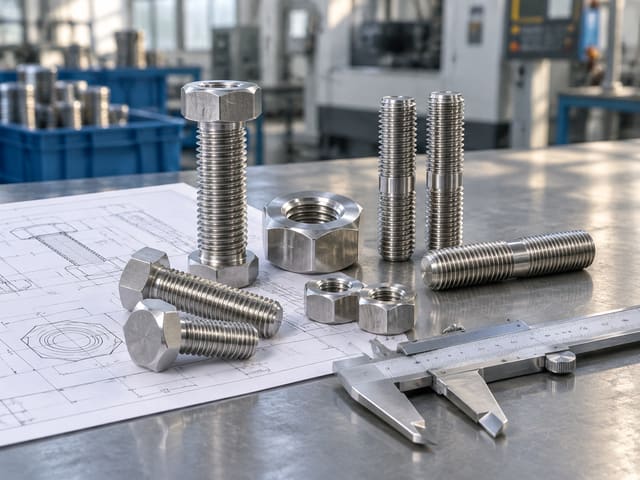
- Hex BoltsSuitable for the most common bolt-nut connections. During selection, confirm the head across-flats dimension, thread length, shank length, and whether there is sufficient installation space for wrenches and sockets.
- Flange BoltsDistribute contact pressure through the flange surface, suitable for connections with softer contact surfaces or requiring a larger bearing area. During selection, verify the flange surface structure, mating hole diameter, and assembly torque requirements.
- StudsSuitable for structures requiring connection at both ends or frequent disassembly; the thread specifications at both ends, overall length, and thread engagement depth must be specified.
- Lock NutsUsed to reduce the risk of loosening in vibrating environments. During evaluation, judge applicability based on operating temperature, number of disassembly cycles, and locking method (such as nylon insert or metal locking structure), rather than replacing ordinary nuts across the board.
- Carriage BoltsCommonly used at connection points requiring anti-rotation and a round-head appearance;Self-tapping ScrewsandSelf-drilling Screwsare suitable for thin sheets or base materials requiring self-drilling;Machine Screwsare mostly used for precision assembly;Expansion Boltsare used for fixing to substrates such as concrete. These categories must be selected separately according to substrate, installation method, and load-bearing purpose; specification verification cannot be skipped just because the names are similar.
- Non-standard structures can be evaluated forcustom socket head cap screws,Custom special-shaped fastenersornon-standard fastener machiningplan, but be sure to freeze the drawings and acceptance criteria before placing an order, and avoid verbal agreements.
Taking self-tapping products as an example, DIN 7973 slotted pan head self-tapping screws use a single straight slot and a raised countersunk structure, suitable for assembly scenarios that require a pan head bearing surface and allow slotted tool operation; while DIN 7972 slotted countersunk head self-tapping screws (corresponding to ISO 1482) use a countersunk structure, and after tightening the head can be flush with the substrate surface, suitable for occasions pursuing a flat appearance and general assembly. The two look similar, but the head structure and assembly effect are different, so when selecting, they should be distinguished according to the assembly surface requirements rather than used interchangeably.
Step 2: Verify dimensions, threads and standards
Dimensions and threads are the most error-prone links in fastener procurement and the ones most likely to cause batch scrapping.
- Confirm nominal diameter, length, pitch, thread form, thread tolerance and thread profile item by item. Do not place orders based solely on the appearance or verbal description of old parts; after old parts wear, the measured values themselves may be distorted.
- Confirm whether the metric or imperial system is used. For projects involvingAmerican standard bolt exports, the applicable standards, units, strength markings and inspection requirements should be clarified at the inquiry stage to avoid discovering standard inconsistencies only after production is completed.
- Verify whether hole diameters, washers, nuts and mating parts match, and check wrench clearance, effective engagement length and assembly sequence. Insufficient engagement length is one of the common causes of vibration loosening.
- When drawings, samples and purchase order information are inconsistent, clarify in writing first and keep version records; do not let procurement unilaterally "judge by experience."
Step 3: Select materials, strength grades and surface treatment
Materials and surface treatment directly determine the service life of fasteners under specific working conditions, and should be considered in sync with the connection design during selection.
- Carbon steelis suitable for common structural connections, but materials, performance grades and coatings must be selected according to load, environment and anti-corrosion requirements. Carbon steel nut products are cost-effective in dry indoor environments, but in humid or outdoor environments they must be paired with corresponding anti-corrosion treatment.
- Stainless steel fastenersare suitable for scenarios with corrosion resistance requirements. When selecting materials, consider at the same time the medium type, working temperature, strength requirements, mating part materials, and the risk of galling (cold welding) that may occur between stainless steels; when necessary, use anti-galling coatings or pair different materials.
- Hot-dip galvanized boltsrequire verification of coating thickness requirements, thread fit allowance and matching nuts, to avoid focusing only on anti-corrosion performance while ignoring the impact of the coating on assemblability. Excessive coating thickness may make it difficult to screw on nuts.
- High-strength boltsshould be selected consistently with the connection design, preload requirements and matching parts (nuts, washers). One cannot judge that they are more suitable merely because of "higher strength"—if high-strength bolts are insufficiently preloaded, they may actually be less reliable than ordinary bolts matched to the design.
- Require suppliers to provide material certificates, performance grade information and surface treatment records. For special projects, sampling inspection and re-inspection rules should be agreed in advance, and inspection responsibilities written into the contract.
Step 4: Prepare an executable inquiry and procurement list
A clearly structured inquiry list can significantly reduce inconsistent quotation bases and subsequent disputes.
- Establish an independent line item for each material: name, applicable standard, specification, material, grade, surface treatment, drawing version, quantity, packaging and delivery time. Do not combine different specifications into one quotation line.
- Distinguish between product unit price and total procurement cost, and proactively ask about possible additional costs such as mold fees, testing fees, packaging fees, transportation fees, tariffs or export document fees.
- Require quotations to state the minimum order quantity, sample policy, production cycle, payment terms, quotation validity period and quality objection handling method.
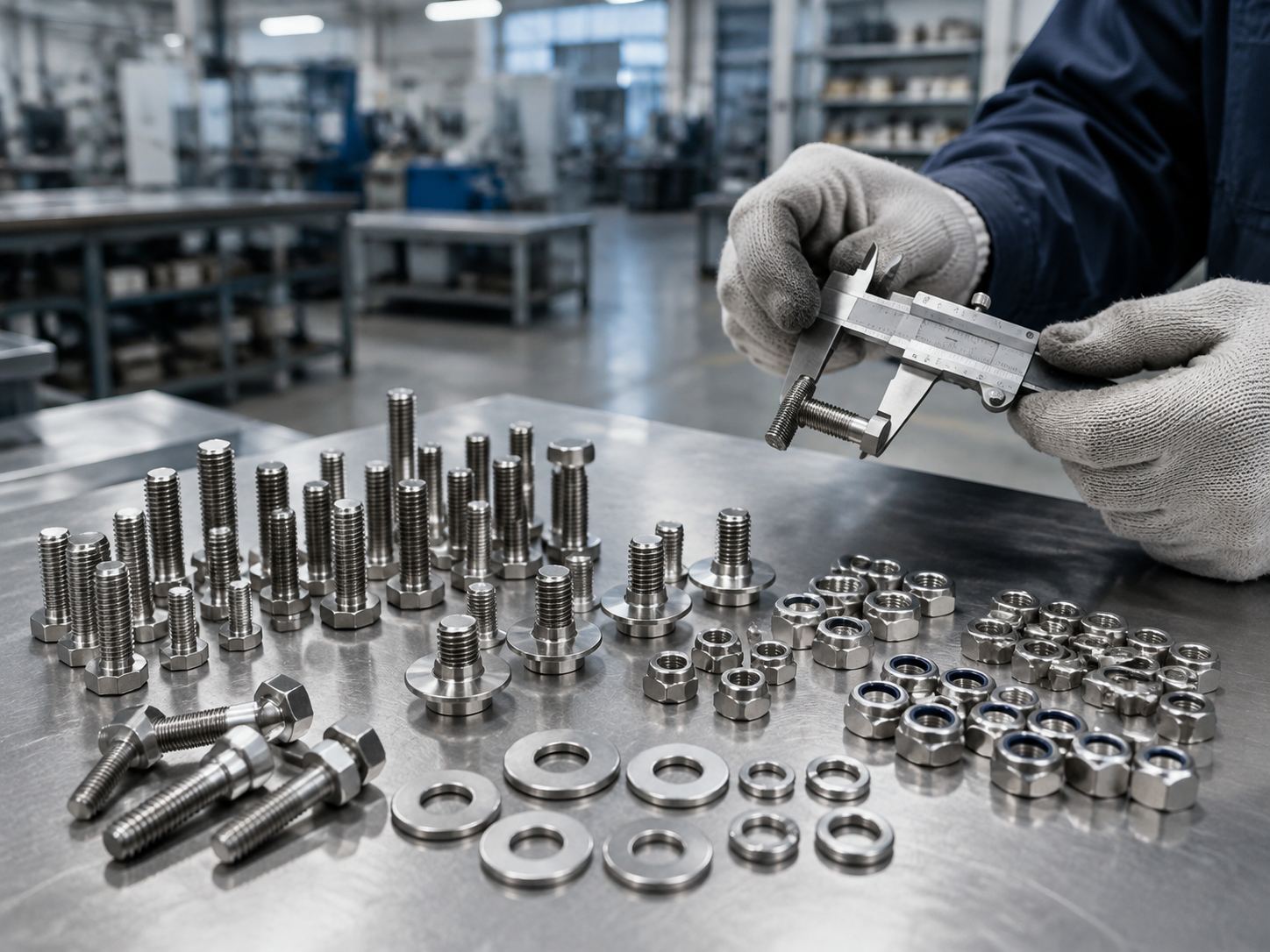
- Before bulk procurement, first make samples or small-batch trial assembly, focusing on checking dimensions, go/no-go thread inspection, assembly feel and working condition adaptability. Trial assembly records should be retained as a reference for batch acceptance.
- Incorporate batch traceability, change notification, delivery documents, and nonconforming product disposition into the order terms, especially forfastener OEM contract manufacturingprojects.
Step 5: Screen fastener suppliers and conduct factory audits
Supplier capability determines how well all the preceding requirements can be implemented. During initial screening offastener manufacturersorfastener suppliers, verify their product range, in-house or outsourced production capability, quality system, delivery record, and export experience.
It is recommended to match suppliers by category rather than finding a single trader that "does everything" to handle it all. Evaluate separatelyhex bolt manufacturers,flange bolt suppliers,carriage bolt factories,heavy hex nut manufacturersandlock nut suppliersto see whether they have stable process expertise in the corresponding categories.
When dealing withstainless steel fastener manufacturers,high-strength bolt manufacturers,hot-dip galvanized bolt suppliersorcarbon steel nut factories, focus on verifying material sources, key processes (such as heat treatment and galvanizing), and testing capabilities. Unclear material sources are the biggest risk point for high-strength and anti-corrosion parts.
The following items should be checked during the on-site factory audit:
- Are raw material markings and zoning clear, and are different materials and different batches physically segregated?
- Are equipment status and process parameter controls recorded?
- Are measuring tools within their calibration validity period, and are inspection records complete and traceable?
- Can batch traceability trace finished products back to raw material batches?
- Is the warehouse protected against material mixing, and are nonconforming products effectively segregated with disposal records?
At the same time, the boundary between in-house production and outsourcing must be assessed. Forfastener OEM contract manufacturing,custom special-shaped fastenerandnon-standard fastener machiningprojects, drawing confidentiality measures, change approval processes, and first-article confirmation processes should be confirmed. The more outsourced processes there are, the harder traceability becomes, and the more written agreements are needed.
Different procurement models require separate verification of actual supply and quality control capabilities:self-tapping screw manufacturers,self-drilling screw suppliersshould be checked for their head forming and thread machining capabilities;machine screw wholesale,expansion bolt wholesaleorcustom bolt wholesalerequires confirmation of their inventory sources, sorting capabilities, and batch consistency. The risk of mixed batches under wholesale models is often higher than with direct production.
Export procurement should also confirmfastener export suppliers' ability to handle packaging, labeling, documents, destination standards, and delivery requirements.U.S.-standard bolt exportprojects especially need standards and acceptance documents aligned at the inquiry stage, including strength markings, unit labeling, and inspection report formats.
Step 6: Set incoming material acceptance and batch release standards
Acceptance standards should be determined before placing an order, not negotiated on an ad hoc basis after the goods arrive.
- When materials arrive, check the quantity, markings, packaging, and batch information against the order, drawings, and samples. Batches with unclear markings should be held from release.
- Set sampling inspection items based on risk: critical dimensions, thread go/no-go gauging, material or hardness, coating thickness, and appearance. High-risk items may require third-party testing or re-inspection.
- Clearly define the sampling ratio, acceptance criteria, re-inspection method, and the handling process for nonconforming batches, so that rules are not added only after a dispute arises.
- Keep inspection reports, material certificates, supplier batch numbers, and installation location records to facilitate subsequent quality traceability and supplier evaluation.
Step 7: Validate procurement results through trial use and review
Whether procurement is successful ultimately depends on assembly site and operating performance, not on whether incoming inspection passes.
- Conduct trial assembly and operation verification on representative equipment or workstations, and record assembly efficiency, loosening, jamming, corrosion, and disassembly conditions.
- Review the purchase price together with rework, downtime, repair, and inventory costs, to avoid comparing only per-unit quotations. If low-priced parts lead to frequent replacement, the total cost is often higher.
- If a failure occurs, first distinguish whether the cause is selection, design, assembly, material, or manufacturing, and then work with the supplier to develop corrective measures; do not immediately attribute it to incoming material quality.
- Update supplier evaluations based on qualified batch rate, on-time delivery, response to quality objections, and continuous improvement performance, forming a reusable list of qualified suppliers.
Procurement and factory audit checklist ready to copy and use
- Before procurement:Purpose and operating conditions confirmed; drawings or standards frozen; specifications, materials, strength grades, and surface treatment written into the list.
- During inquiry:Samples, minimum order quantity, lead time, packaging, inspection documents, change rules, and handling of nonconforming products have been asked about item by item and recorded.
- During factory audit:Raw material traceability, process control, testing equipment, calibration records, batch management, and outsourcing management have been checked on site.
- After receipt:Quantity and markings checked; dimensional and performance inspections completed; batch records and inspection results archived.
- Information source note:Existing research materials do not provide verifiable fastener industry statistics or directly quantifiable procurement ROI, so this article does not cite unverified market figures; actual results should be evaluated based on the company's own trial records and review data.