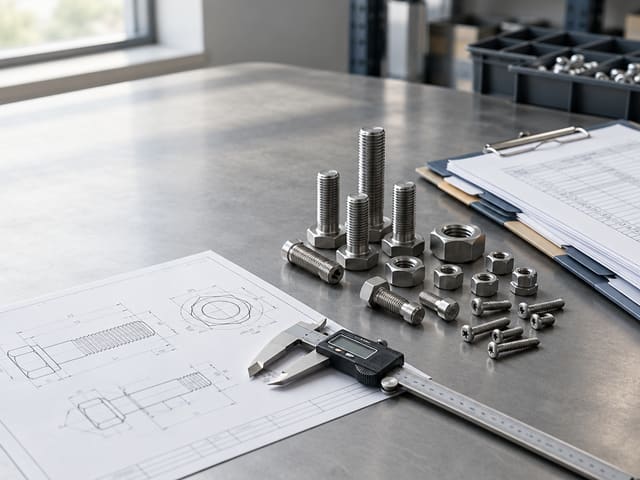
Don't Judge Fastener Procurement by Unit Price Alone: Use TCO to Calculate the True Cost

Daniel
With experience in fastener manufacturing and export sales, we specialize in bolts, nuts, screws, self-drilling screws, fully threaded rods, and customized fastening solutions for construction, machinery, automotive, and industrial applications.
Introduction: Quotes Are Lower, So Why Haven't Procurement Costs Fallen?
Many procurement professionals have encountered this scenario: the quotes for a batch of screws, nuts, or bolts come in a few points lower than before, which looks like a good negotiation result. But after the goods arrive at the factory, problems gradually surface—the incoming inspection failure rate rises, requiring additional manual sorting; on the assembly line, thread stripping, dimensional deviations, or uneven plating appear, leading to more rework and scrap; delivery delays then trigger expedited shipping and production scheduling adjustments. By the quarterly review, the actual expenditure reported by finance turns out to be higher than before.
The root cause is often not a lack of effort by procurement staff, but rather too narrow a basis for comparison: only the unit price per piece was compared, without putting transportation, inspection, inventory, assembly, quality losses, and line-stoppage risks into the same procurement cost table. Unit price is the number quoted by the supplier, whereas what the company actually pays is the cost of the entire chain from order placement to consumption.

The goal of this article is to provide a reusable total cost of ownership (TCO) breakdown method to help B2B buyers look beyond unit price and at controllable total cost when comparing fastener quotes.
First, unify the basis: procurement unit price is not the same as landed cost
Before doing the math, it is necessary to separate three easily confused concepts:

- Supplier quote: the ex-works unit price a supplier gives for a certain specification and quantity, usually excluding freight, tariffs, and inspection costs.
- Landed procurement cost: the quote plus packaging, transportation, insurance, tariffs, customs clearance, and pre-warehousing inspection fees.
- Full life-cycle total cost: landed cost plus the costs of warehousing, capital tie-up, assembly use, quality losses, after-sales handling, and supply interruption risks.
On this basis, a basic formula can be established as the framework for filling in the table later:
TCO = procurement amount + logistics and tariffs + inspection and warehousing + assembly cost + quality losses + delivery and supply risk cost − confirmed residual value or rebates
Particular emphasis must be placed on the comparison premise: quotes are only comparable after unifying specifications, material, strength grade, surface treatment, packaging method, delivery location, payment terms, and acceptance standards. Hex bolts, flange bolts, studs, or stainless steel fasteners of different specifications cannot be compared horizontally by name or per-piece price alone. Even for the same M8 bolt, grade 8.8 versus 10.9, zinc-plated versus stainless steel, and coarse thread versus fine thread have completely different cost structures.
A TCO procurement cost table: which items are recommended
A useful procurement cost table should cover the complete chain from order placement to consumption. It is recommended to organize it into the following six groups:
Procurement items
- Tax-inclusive unit price, procurement quantity, annual demand
- Mold fees, sampling fees, sample validation costs
- Minimum order quantity (MOQ) and its impact on inventory
- Payment terms, financing cost of payment terms, and exchange rate fluctuation cost
Delivery items
- Packaging method and packaging cost
- Domestic and international transportation costs, insurance costs
- Tariffs, customs clearance fees, and various miscellaneous charges
- Expedited shipping costs, additional costs arising from partial deliveries
Acceptance and inventory items
- Incoming inspection labor hours, sampling ratio, third-party testing fees
- Warehouse space occupied, warehouse management costs
- Capital occupation cost, slow-moving inventory and safety stock cost
Items used in production
- Sorting, picking, and rework labor hours
- Assembly labor hours, tool wear, risk of incorrect or missing installation
- Production line downtime losses and takt time impact
Quality and after-sales items
- Scrap of nonconforming products and return/exchange processing costs
- On-site repair, customer claims and recall costs
- Batch traceability management and quality document maintenance costs
Suggested table fields
The table itself is recommended to include six columns: cost item, calculation basis, supplier A, supplier B, data source, risk notes. The "data source" column is very critical, as it forces every figure to have a source and avoids rough guesswork; the "risk notes" column is used to record hidden risks that cannot yet be quantified but must be flagged, such as single-source dependency or inconsistent standard versions.
Work through an example: why total cost may rise when the unit price drops 5%
The following simplified example illustrates the logic. Assume a batch of fasteners was originally quoted at 100,000 yuan, and another supplier quotes 5% lower, reducing the purchase amount to 95,000 yuan. The following additional costs are for demonstration purposes only; actual calculations should be based on the company's own data.
- Increased inspection and sorting: 2,000 yuan (insufficient batch stability, higher sampling ratio)
- Increased rework and scrap: 3,000 yuan (dimensional or thread fluctuations cause assembly abnormalities)
- Expedited shipping and scheduling losses due to delays: 4,000 yuan
- Increased inventory and management costs: 1,500 yuan (large minimum order quantity, delivery batches do not match)
Adding these figures back, the actual cost of the low-price option is 95,000 + 2,000 + 3,000 + 4,000 + 1,500 = 105,500 yuan, which is 5,500 yuan higher than the original option's 100,000 yuan. In other words, 5,000 yuan was saved on the unit price, but additional costs reached 10,500 yuan.
This example does not represent the industry average; its value lies in illustrating a way of thinking: the key is to fill in the table with your own company's defect rate, inspection labor hours, delay losses, and inventory data, replacing assumptions with real data, so as to reach conclusions that apply to your own situation.
The six types of hidden costs most easily overlooked
In practice, the following six types of costs are most often ignored, yet they often determine the level of TCO:
- Quality consistency: Fluctuations in dimensions, thread precision, hardness, coating thickness, or material composition may cause screws, nuts, and bolts to strip, loosen, corrode, or otherwise fail during assembly or use. For load-bearing or high-safety applications, the cost of a single failure may far exceed the purchase amount of the entire batch.
- Inspection burden: When the material certificates and test reports provided by the supplier are incomplete, or batch stability is insufficient, companies are often forced to increase sampling ratios, increase re-inspection frequency, and even add on-site supplier audits—all of which are real labor-hour costs.
- Delivery fluctuation: Delayed delivery may trigger expedited logistics, production plan rescheduling, line stoppages due to material shortages, and even delivery breaches to downstream customers. For production lines with tight takt times, the loss from one hour of downtime often exceeds the price difference of a batch of fasteners.
- Inventory occupation: An excessively large minimum order quantity and delivery batches that do not match the production rhythm will lead to capital occupation, warehousing costs, and slow-moving risk. Low prices are often accompanied by large-volume commitments, and this part of the cost must be included.
- Specification fitIf alternative materials, surface treatments, or dimensional tolerances are switched without completed verification, it may cause assembly difficulties, increased tool wear, and higher subsequent maintenance and replacement costs.
- Supply continuityWhen overly dependent on a single source, its capacity flexibility, stocking capability, change notification mechanism, and exception handling process should be evaluated. The cost of supply interruption is hard to reflect on a quotation sheet, yet it truly exists.
Evaluate cost by product and application scenario, not just by category name
The cost drivers of different fasteners vary greatly, and evaluation must be combined with the specific application scenario.
For applications with high load-bearing or safety requirements, the material certificates, property classes, inspection records, and batch traceability requirements of bolts and nuts should be verified. In such scenarios, price differences often correspond to differences in materials and processes, and a low price may mean simplification of heat treatment or inspection steps.
For outdoor or corrosive environments, when comparing stainless steel fasteners with other anti-corrosion solutions, service life, maintenance frequency, and application suitability should be evaluated at the same time. Differences in material grades (such as 304 and 316) among stainless steel fastener manufacturers directly affect corrosion resistance performance and long-term maintenance costs.
When hot-dip galvanized bolts, expansion bolts, self-tapping screws, or self-drilling screws are involved, the base material, installation method, environmental conditions, and matching requirements should be verified. For example, differences in wholesale quotations for expansion bolts may come from different sleeve materials, screw strength, or coating processes; the drill point design of self-drilling screws and the thread form of self-tapping screws also directly affect construction efficiency and rework rates.
In panel and equipment assembly scenarios, the head form also affects assembly cost. TakingCross Recessed Countersunk Machine Screw DIN 965as an example, this is a cross-recessed countersunk machine screw with metric threads. It adopts a countersunk head design, so after tightening, the head can be flush with the workpiece surface, making it suitable for electrical equipment, furniture, and panel assembly where appearance and fit are required. Carbon steel, stainless steel, and brass materials are available. For equipment panels that require frequent disassembly or have limited space,Button Head Socket Screw ISO 7380-1provides a low-profile button head shape and hex socket drive, making it convenient for use in machinery, furniture, and equipment panel assembly, and it also offers alloy steel and stainless steel options. The reflection of these two types of products in the TCO table is not only the unit price but also assembly efficiency, tool compatibility, and appearance rework rate.
Non-standard or customized projects should include the costs of drawing review, sample verification, molds or tooling, change management, and subsequent repeat purchases. Custom special-shaped fasteners and non-standard fastener machining have high initial investment, but if annual usage is stable, the total cost allocated to each piece may be better. This point needs to be judged with data rather than intuition.
How to fairly compare quotations from fastener suppliers
To make quotations comparable, the criteria need to be unified at the inquiry stage:
- Issue a unified inquiry document: include drawings and specifications, materials, property classes, surface treatment, packaging method, inspection standards, annual usage, delivery schedule, and delivery location. The more complete the document, the fewer disputes later.
- Require itemized quotations: product unit price, mold or sampling fee, packaging fee, freight, testing fee, lead time, and quotation validity period should be listed separately for item-by-item comparison.
- Evaluate supplier capabilities: when evaluating fastener manufacturers or fastener suppliers, check their quality system certifications, batch traceability capability, capacity arrangements, exception response speed, and change control processes. These soft capabilities often determine the level of hidden costs.
- Use the corresponding checklist by category: for different categories such as hex bolt manufacturers, flange bolt suppliers, heavy hex nut manufacturers, or lock nut suppliers, corresponding technical and acceptance checklists should be used rather than one generic form for everything.
- Additional confirmation for export and customized projects: when purchasing US-standard bolts for export, custom special-shaped fasteners, non-standard fastener machining, or fastener OEM contract manufacturing, additional confirmation is required for standard versions (such as differences between ANSI/ASME and DIN/ISO), document language, packaging markings, and division of export delivery responsibilities.
- Do not replace qualification conclusions with keywords: searched keywords only represent product categories, not the supplier's actual capabilities. Sample testing, quality documents, on-site audits, and actual delivery records should be used as the basis for verification.
For specific needs such as custom hex socket screws, machine screw wholesale, carbon steel nut factories, and custom bolt wholesale, it is also recommended to clarify acceptance standards and nonconforming handling clauses at the inquiry stage, putting quality responsibility into the contract in advance rather than leaving it for negotiation after arrival.
Establish executable procurement decision rules
With a cost table in hand, you also need a set of rules to make it truly effective in day-to-day decisions:
- Set admission thresholds: First confirm whether technical specifications, quality requirements, and delivery capability meet the standards, then compare TCO among qualified suppliers. Quotes that do not meet the threshold should not enter the price comparison process, no matter how low the unit price is.
- Assign evaluation weights: Weights can be set for quality, delivery time, total cost, service, and supply risk according to the company's actual situation, so as to avoid the lowest quote alone determining the winning result.
- Conduct sensitivity analysis: Test changes in defect rate, transportation costs, delivery delay days, and annual demand separately, identify the variables with the greatest impact on total cost, and focus management attention on the key areas.
- Keep a validation stage: For new suppliers or new specifications, first conduct sample validation, trial production, and small-batch trials before deciding whether to increase the procurement share. Switching between high-strength bolt manufacturers or hot-dip galvanized bolt suppliers especially requires this step.
- Set up a review mechanism: Update actual quality costs, delivery performance, and inventory data quarterly or by project cycle, and use real results to calibrate the next round of procurement decisions, so that the cost table becomes more accurate the more it is used.
Conclusion: Upgrade procurement from comparing unit prices to comparing controllable total costs
Returning to the question at the beginning: a 5% drop in unit price does not mean procurement is more economical. Only when quality, delivery, inventory, and usage costs are also controlled simultaneously do the savings truly show up in the financial statements. Unit price is the starting point of negotiation; TCO is the basis for decision-making.
Action recommendations can be very specific: first select a fastener category with large procurement volume and relatively complete quality data, build the first TCO cost table, and use actual data to compare the existing solution with the new quote. Even if the first version of the table has only seven or eight fields and some figures are still estimates, it is still far closer to the truth than simply comparing unit prices.
In the next round of inquiries or supplier evaluation, it may be worthwhile to submit unified specifications, acceptance standards, and delivery requirements together, and require the other party to provide comparable and traceable quotes and cost breakdowns. When suppliers are willing to lay out their cost structure openly, the buyer truly has a basis for comparison.